Most teams adopting AI in 2026 pick the wrong technique.
Not because they aren't smart. Because the choice between prompting, RAG, and fine-tuning gets framed as a tooling debate when it's actually a problem-shape debate. Teams arrive convinced they "need RAG" or "need fine-tuning" and end up six months in, having built infrastructure that doesn't solve the problem they had.
Here's the framework I use when teams ask me which one they need. Spoiler: most of the time, they need a better prompt first. And when they genuinely do need more, they often need both RAG and fine-tuning — solving different parts of the same problem.
The three approaches in 90 seconds
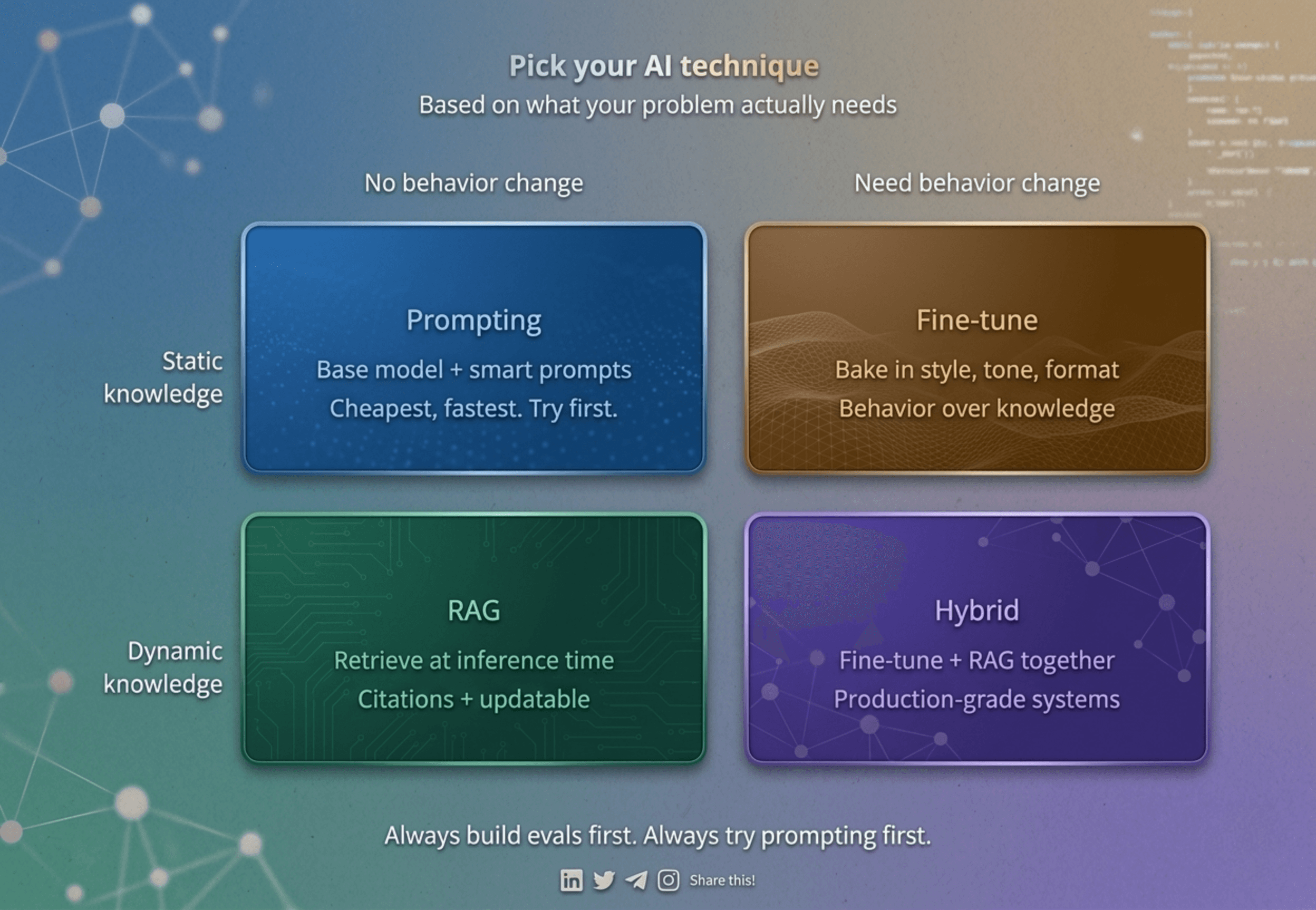
Prompting means changing the input, not the model. Zero-shot, few-shot, chain-of-thought, system prompts with examples. The cheapest and fastest option. Limit: the base model has to already know enough about your domain to be useful.
RAG (Retrieval-Augmented Generation) means fetching relevant documents from a knowledge base at inference time and injecting them into the context window. Moderate cost (embeddings, vector DB, larger contexts). Limit: garbage retrieval gives you garbage answers — confidently delivered.
Fine-tuning means updating the model's weights with domain-specific examples. Usually LoRA or a full fine-tune. Most expensive in time and money. Limit: knowledge gets baked in, so updates require retraining.
That's the technical surface. The interesting question is when each one actually wins.
When each one wins
Prompting wins when
The base model already knows your domain well enough. You're building an MVP and need to learn what works before investing in infrastructure. The task is general — summarization, classification, content generation, code completion. Cost and latency matter, and a great prompt with the strongest available model is genuinely enough.
I see teams skip this step constantly. They've decided they need RAG before they've tried the strongest model with a thoughtful system prompt. Sometimes the prompt-only baseline is 90% of where they need to be — and the remaining 10% doesn't justify a vector database.
RAG wins when
You have private or proprietary knowledge the model doesn't have access to. Your knowledge changes — docs get updated, prices move, products evolve, regulations shift. You need citations or source attribution because hallucinations have real consequences (legal, medical, financial, contractual). You want to scale knowledge without retraining the model every time something changes.
The big tell for RAG: when the question "where did the model get that?" matters more than "how fluent does the answer sound?"
Fine-tuning wins when
You need a specific style, tone, or output format — consistently. The base model has the knowledge but not the behavior you need. You're optimizing for inference cost at scale — a smaller fine-tuned model can often beat a larger general one for narrow tasks. You have proprietary structure or reasoning patterns that a prompt can't fully encode no matter how clever you get.
Fine-tuning is about behavior, not facts.
Hybrid wins when
You need domain behavior (fine-tune) and dynamic knowledge (RAG). Production systems that need to feel cohesive and stay current usually land here. The classic example: a legal AI fine-tuned on legal reasoning patterns, with RAG pulling current case law. Either alone fails. Together they ship.
The decision tree, condensed
Ask yourself, in this order:
- Do I have evals? If no, stop. Build them. You cannot improve what you don't measure.
- Does the base model already know enough? If yes, prompt better.
- Do I need knowledge it doesn't have? If yes, RAG.
- Do I need behavior it doesn't have? If yes, fine-tune.
- Both? Both.
The matrix way to see it: behavior change on one axis, dynamic knowledge on the other. Four quadrants, four answers.
Five mistakes I keep seeing
1. Fine-tuning to inject facts
Don't. Fine-tuning is for behavior, not knowledge. If you fine-tune a model on your product docs, you're spending a lot of money to do badly what RAG does cheaply. Plus, when your docs change, your model is now confidently wrong forever. Facts go in retrieval. Behavior goes in weights.
2. RAG without solving retrieval
Half-good retrieval gives you hallucinations dressed up as confidence. Before you blame the LLM, audit the pipeline. Are you chunking sensibly for your document structure? Are you re-ranking after the initial vector search? Are you embedding the right representation of your docs — or just the raw text? RAG quality is mostly retrieval quality. The LLM is the last step, not the bottleneck.
3. Optimizing before measuring
I've watched teams burn three months "improving the prompt" without a single repeatable eval. They iterate on vibes, ship something that feels better, then can't tell whether the next change made it worse. Build a golden dataset of 50-200 representative inputs and expected outputs before you optimize anything. The first eval is the highest-leverage thing you can build.
4. Picking the technique before defining the problem
"We need RAG" is not a problem statement. "Our support agents get 200 tickets a day asking about pricing and our chatbot keeps inventing prices" is. The problem shape tells you the technique. When teams pick the technique first, they end up bending the problem to fit the tool — which is how you ship infrastructure that doesn't move any metric.
5. Skipping the prompting baseline
Before you spin up a vector database, an embedding pipeline, an evaluation harness, and a fine-tuning rig — try the strongest available model with a great system prompt. Sometimes that's enough. When it isn't, you'll have a clear baseline to beat, and you'll know which capability gap you're actually solving.
Three patterns from real teams
Customer support chatbot. Prompting alone landed at 60% accurate. Adding RAG over their internal docs got it to 92%. Fine-tuning on top of that to match their brand voice was what got it past the legal team for production. They needed all three — but each one was solving a different problem, and the order mattered.
Code review assistant. Just prompting. The strongest available model with a carefully constructed system prompt and a handful of few-shot examples. No RAG, no fine-tuning, no vector database. They saved six months by not over-engineering and shipped a tool the team actually uses.
Legal research tool. Fine-tuning on legal reasoning structure plus RAG over case databases. Either alone failed in user testing. Together, they passed. The fine-tune taught the model how a legal answer should be shaped; RAG provided the current law to shape an answer about.
What this actually means for you
The technique isn't the win. Solving the problem is. Pick the smallest thing that works, and only add complexity when measurement tells you to.
If you're starting today: try prompting with the best model you can access. Build evals before you optimize. If you can't beat the prompt-only baseline with RAG or fine-tuning, you don't need them yet — and adding them will make your system slower, more expensive, and harder to debug without making it better.
When you do need more, let the problem tell you which one. Knowledge gap → RAG. Behavior gap → fine-tune. Both → both.
If this was useful, I write about ML engineering and building production AI systems on muaazdev.com. Three posts a week. Next up: building your first AI agent in 50 lines — and what nobody tells you about why agents fail in production.